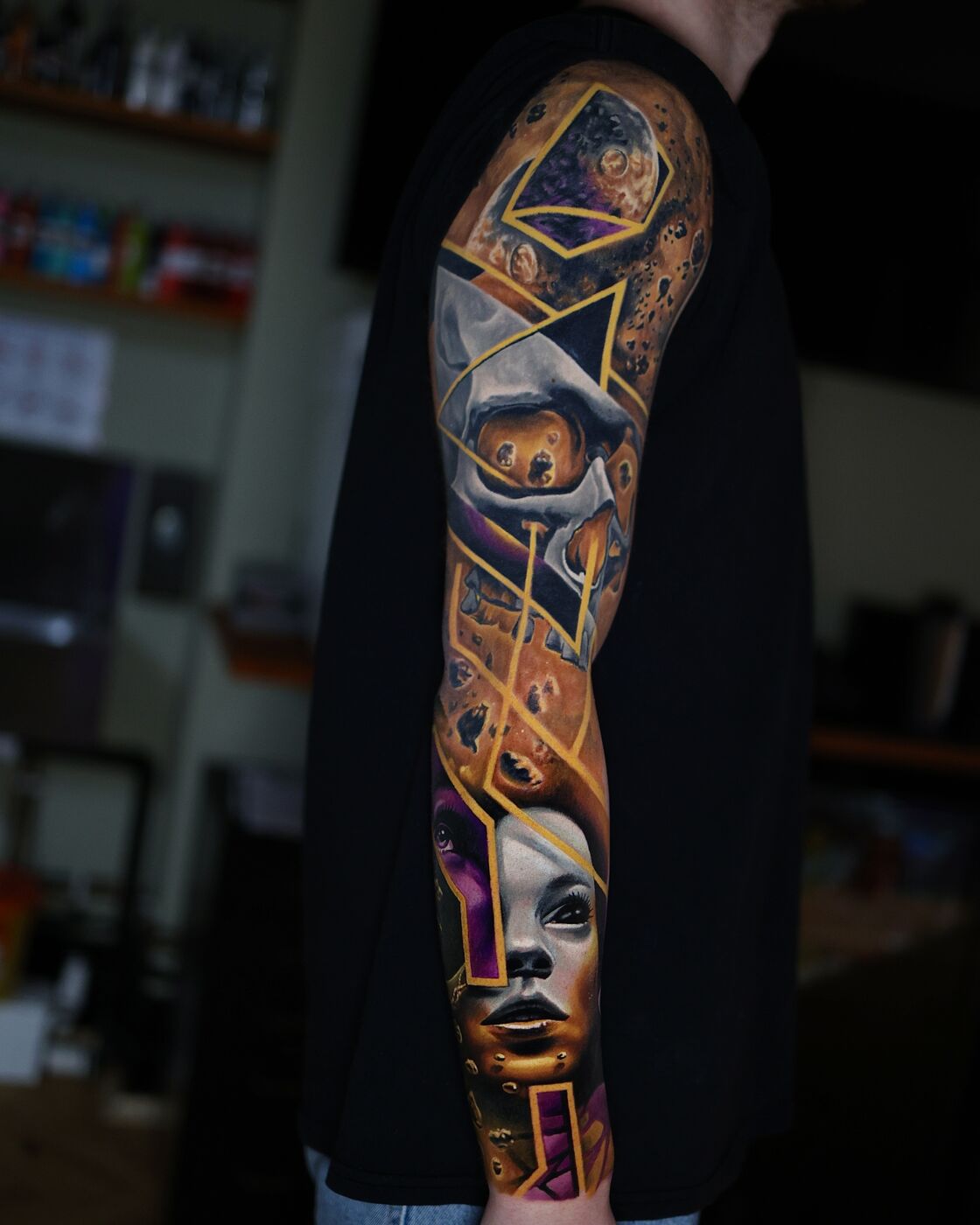
Full sleeve · Modern Japanese Surrealism · Volkan Demirci, London
If you search "Modern Japanese Surrealism tattoo" online, almost every result leads back to one name. That is not a coincidence — it is because Volkan Demirci created the term. Not as a marketing label, but because no existing category was accurate enough to describe what he was doing.
After 25 years of tattooing — starting in Istanbul in 1998, moving through different studios and cities, landing in London — what emerged was something that does not sit neatly inside any single tradition. It draws from Japanese tattooing. It references surrealism. It is grounded in realism. But it is none of these things exclusively.
Where it comes from
Volkan did not come from an art school background. He studied philosophy at university in Turkey — a discipline that teaches you to question categories, not accept them. That instinct is visible in his work: everything is in tension. Dark and light. Structure and chaos. The organic and the architectural.
Two things shifted his trajectory significantly. The first was moving to London. The second was a decision to stop tattooing for a period and focus entirely on improving as a painter — working on canvas, studying anatomy, developing his own compositional layouts. That discipline became the foundation of his signature.
"Two big impacts on my art were moving to London and choosing to improve my skill on canvas. I really wanted to emphasise this because admitting your capability is the key — otherwise you can't improve."
Volkan Demirci · Tattoo Life MagazineWhat makes it different
The most visible quality in Volkan's work is colour. Not colour as decoration — colour as structure. His palettes are built on contrast, and the result tends toward what he describes as yin and yang: opposing values that resolve into balance. Deep shadows against vivid saturation. Warmth against cool. The compositions look alive because the tension is never fully resolved — it keeps the eye moving.
The second quality is how the design relates to the body. Traditional Japanese tattooing has always respected the body's form — the way muscles move, how skin stretches, where the eye naturally travels. Volkan's approach takes this further. Every composition is designed specifically for the person wearing it — their anatomy, their movement, their story. There are no templates.
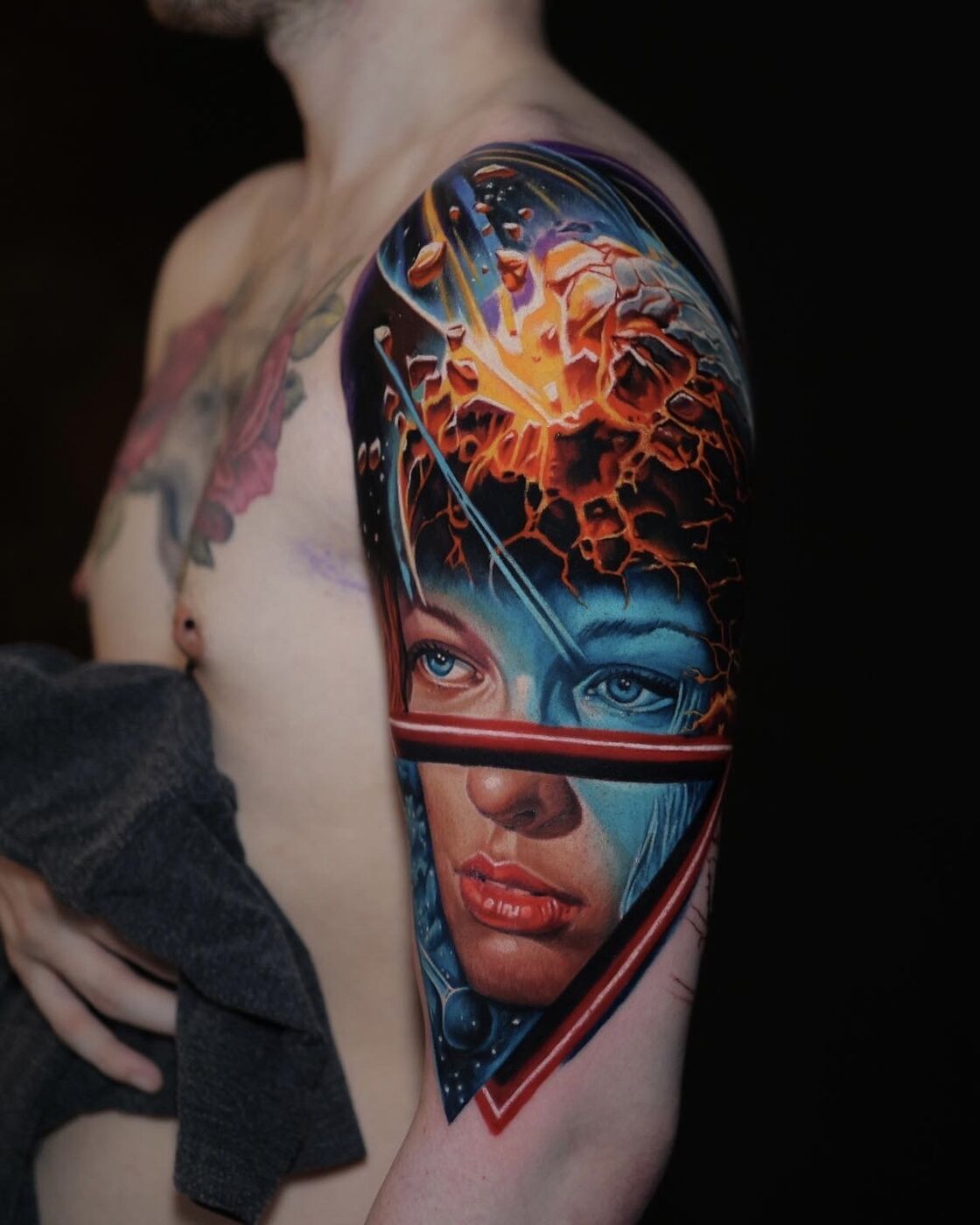
Colour detail · Private studio, Wandsworth, London
The surrealism element
Surrealism in tattooing is often misunderstood as simply "strange" or "unusual" imagery. In Volkan's work it means something more specific: the logic of the piece follows its own internal rules rather than representing the world literally. Faces dissolve into architecture. Natural forms take on structural precision. The familiar becomes unfamiliar — not through distortion, but through recontextualisation.
The influence of philosophy is real here. When you have studied how categories of thought are constructed and questioned, you stop accepting the obvious framing. A flower is not just a flower. A face is not just a face. Everything carries weight that goes beyond its surface appearance.
"My colour palettes are usually based on contrast and whenever I'm trying to create a design, at the end of the day it all looks like a yin and yang. I didn't try to do it on purpose but it is happening — and I think philosophy affected my vision a lot."
Volkan Demirci · Tattoo Life MagazineHow a piece is made
No two designs are alike — and that is not a tagline, it is a practical constraint of the process. Volkan designs every piece from zero, using Procreate on iPad to build the composition before anything touches skin. For larger projects — full sleeves, half sleeves, multi-session work — a dedicated Design Day happens first. Face to face, before a single needle moves.
This matters because Modern Japanese Surrealism is not a style you can apply to any brief. It requires understanding the person wearing it. Their body, their story, what they want to carry permanently. The most satisfying moment in the process, as Volkan describes it, is watching the design take shape and seeing that it is specific — that it could only belong to this person.
- Colour built on contrast — palettes that reference yin and yang without being literal about it
- Composition designed around the body's movement and anatomy, not applied to it
- Surrealist logic — familiar subjects recontextualised, not simply distorted
- Every design created from zero — no templates, no flash, no repetition
- Philosophy as foundation — the work carries meaning that goes beyond surface appearance
Is it for you?
Modern Japanese Surrealism is not for everyone — and that is intentional. It demands commitment: from the artist, and from the person wearing it. The work is large-scale by nature. It takes multiple sessions to realise properly. It requires a client who trusts the process and brings a genuine idea, not just a reference image pulled from a search engine.
If you are looking for something small and quick, this is not it. If you want something designed specifically for you — something that carries real visual weight and will look better as it ages — then this is exactly what Volkan does.
Volkan Demirci works from a private studio in Wandsworth, London. Every project begins with a conversation. Clients travel from across Europe and beyond for his work.