A tattoo done at the highest level can look exceptional for decades. The same tattoo, badly cared for in the first few weeks, can fade, muddy, or lose detail in ways that are difficult and expensive to correct.
The protocol below is exactly what is used at the studio — simple, proven, and based on one principle: your skin is the best healer there is. It does not need products to do its job. It needs to be kept clean and dry, and supported with moisture at the right time. Nothing more.
H2Ocean Blue Green Soap and H2Ocean aftercare cream are provided after every session — complimentary. Both are sea salt-based formulas, fragrance-free, and chosen specifically because they work without interfering with the healing process.
Tattoo Armour
Tattoo Armour is a professional breathable film applied directly over the fresh tattoo, covering the entire area completely. It absorbs plasma while keeping the inner skin clean — protecting the open wound without suffocating it.
It is not the default for every session — the clean and dry protocol below remains the standard. Tattoo Armour is used in two specific situations:
Consecutive two-day sessions: When two sessions run back to back, an antiseptic spray is applied to the area at the end of the first day, then Tattoo Armour is applied over the top. The client returns the following morning wrapped. At the studio it is removed, the area is cleaned and given time to rest, then the second session begins. This keeps the skin in the best possible condition overnight between consecutive sessions.
Optional first 48 hours: For clients who prefer added protection during the initial healing window, Tattoo Armour can be used — but no longer than 4 to 5 hours at a time. Once removed, the standard clean and dry routine takes over immediately.
If Tattoo Armour is used at your session, timing and removal will be explained clearly before you leave.
The protocol — step by step
Do and don't
- Wash 4–5 times daily for the first 48 hours with H2Ocean Blue Green Soap
- Rinse thoroughly — remove all soap residue with lukewarm water
- Pat dry with a clean paper towel — no rubbing, no fabric towels
- Keep the area clean and dry for the first 48 hours — nothing else
- After 48 hours: wait 10–15 minutes after drying before applying cream
- Apply H2Ocean cream in a very thin layer — barely there
- Avoid all sun exposure during healing — 2 to 4 weeks minimum
- Apply any cream or covering in the first 48 hours
- Pick, scratch, or peel flaking skin at any stage
- Apply cream on damp skin — always dry fully first
- Use fragrance products, antiseptic creams, or petroleum jelly
- Submerge in water — no swimming, baths, or hot tubs for 4 weeks
- Wear tight clothing that rubs or restricts airflow over the area
- Go to the gym for the first 3–5 days — sweat and friction both cause problems
The two products
That is all you need. Two products, both provided at the studio, both fragrance-free, both sea salt-based.
"The tattoo on skin is just a finished product — that's 10% of the work. The other 90% is everything that surrounds it: the design, the relationship, the care. All of it matters."
Volkan DemirciFor multi-session work
If you are working on a sleeve or any multi-session project, aftercare between sessions is not only about keeping the current work looking good — it directly affects the quality of the next session.
Skin that has healed properly accepts ink better, produces cleaner lines, and allows for more detail in subsequent sessions. Skin that has been poorly cared for — sun-damaged, dry, or not fully healed — makes the artist's job significantly harder and produces worse results.
The minimum recommended gap between sessions is 6 to 8 weeks. This is not bureaucracy — it is the time the skin genuinely needs to recover at the deeper layers, not just the surface. Compressing this timeline to get the sleeve done faster produces a worse sleeve.
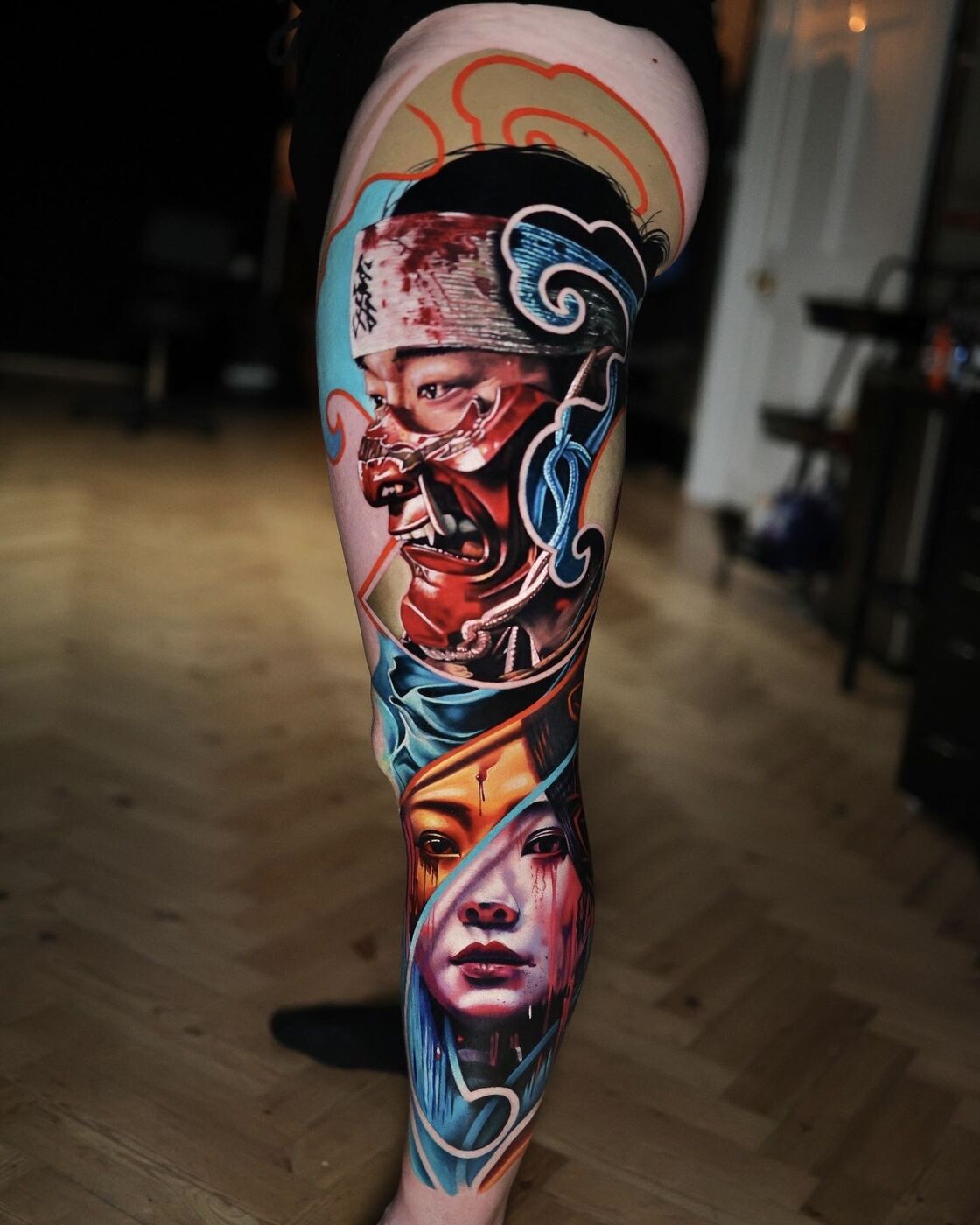
Healed colour sleeve · Volkan Demirci · London
Long-term maintenance
Aftercare guidance is provided after every session at Volkan's private studio in Wandsworth. Touch-ups within the healing period are included as standard. If something looks unusual during healing, get in touch — directly, without hesitation.